Can Blue Spirulina Be Used in Your Market? A Guide to Blue Spirulina Regulations Worldwide
Blue Spirulina Regulations Overview
As demand for clean-label and naturally sourced ingredients continues to grow, Blue Spirulina has become one of the most widely adopted natural blue color solutions in the global food and beverage industry.
From confectionery and beverages to dairy alternatives and nutritional products, brands are increasingly turning to Spirulina-derived blue ingredients as alternatives to synthetic colorants.
However, before evaluating color performance, stability, or formulation compatibility, companies must first address a critical question: Can Blue Spirulina legally be used in the target market?
The answer depends not only on the country involved, but also on how Blue Spirulina is manufactured, classified, and intended to be used under different regulatory frameworks.
While regulatory frameworks differ across regions, Blue Spirulina Regulations are generally based on a set of shared classification factors, including ingredient source, manufacturing process, and intended functional use in food applications.
Blue Spirulina Regulations: A Global Market Compliance Guide
European Union – Spirulina Extract EU Regulations
From a regulatory perspective, Spirulina Extract in the European Union is assessed not only by ingredient origin but also by its manufacturing process and the extent to which the original food matrix is retained.
One of the most important aspects of Spirulina Extract EU Regulations is determining whether the ingredient is classified as a colouring food or a food additive.
According to European Commission guidance, food extracts obtained through non-selective processing and retaining the essential characteristics of the source material may be considered Coloring Foods.
Conversely, products produced through selective extraction or concentration of coloring constituents may be evaluated differently.
As a result, regulatory classification of Spirulina-derived blue ingredients cannot be determined solely by ingredient name. Manufacturing process, composition, and supporting documentation all play important roles.
For this reason, companies entering the European market should evaluate their products on a case-by-case basis rather than assuming all Spirulina Extract products fall under the same regulatory category.
Regulatory Resources
- European Commission – Food Additives Regulatory Framework
- NatCol – Guidance on Colouring Foods Classification
- International Association of Color Manufacturers (IACM) – Spirulina Extract Regulatory Profile
United States
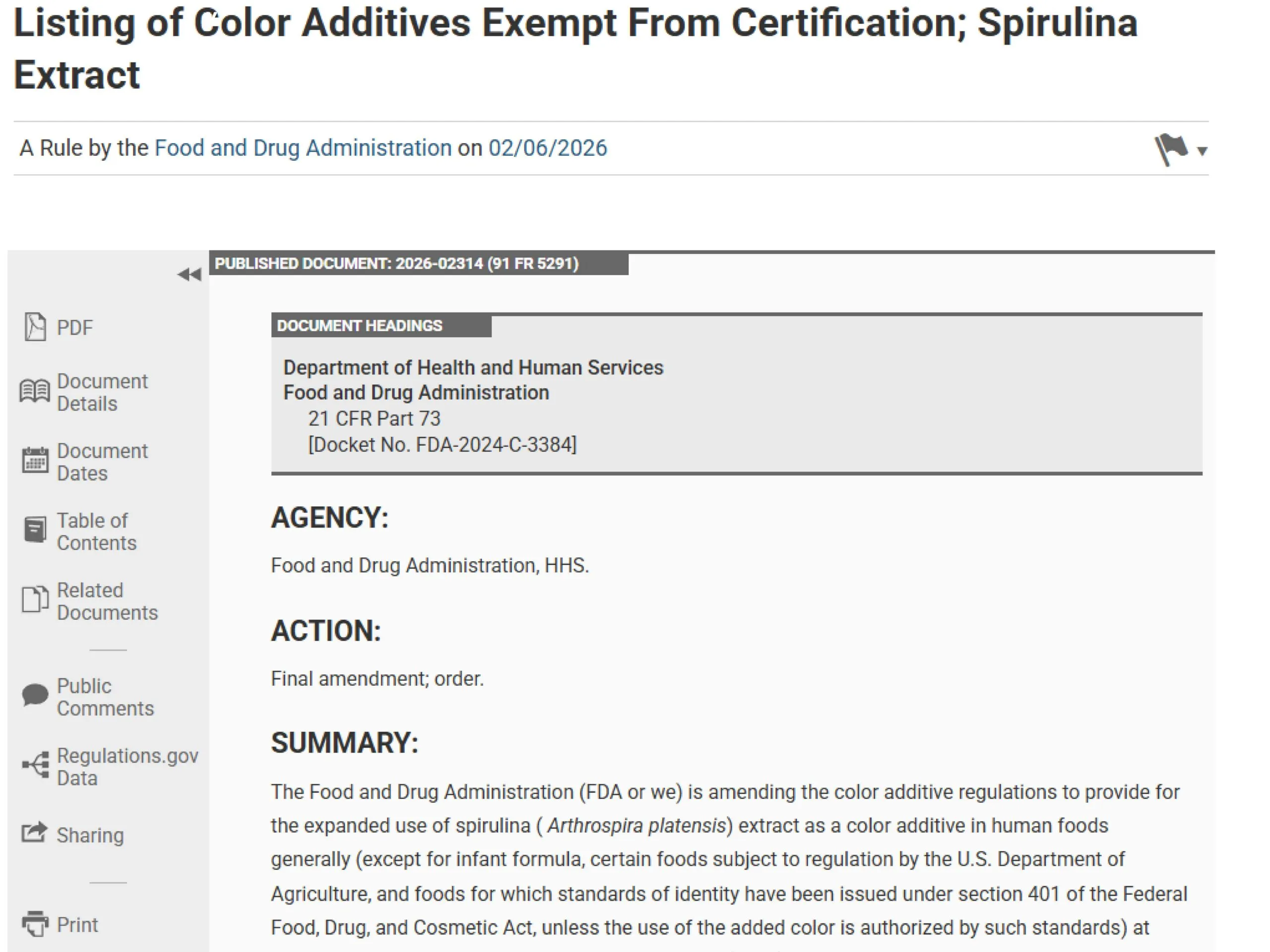
Spirulina Extract is regulated under 21 CFR 73.530 as a color additive exempt from certification in the United States. It is defined as a filtered aqueous extract of Arthrospira platensis with phycocyanin as the principal coloring component.
From a regulatory standpoint, Spirulina Extract is classified as an approved color additive for specified food applications under FDA regulations.
FDA first authorized its use in 2013 for selected food categories, including confectionery and chewing gum. Regulatory permissions were subsequently expanded to additional applications such as beverages, dairy alternatives, ice cream, coatings, and certain dietary supplement uses, reflecting its increasing adoption in food formulation.
As a result, Spirulina Extract is widely recognized as one of the most established natural blue color solutions in the U.S. market.
Regulatory Resources
- U.S. Food and Drug Administration (FDA) – 21 CFR 73.530
- Federal Register – Color Additive Rulemaking (Spirulina Extract)
Japan – Spirulina-Derived Color Regulations
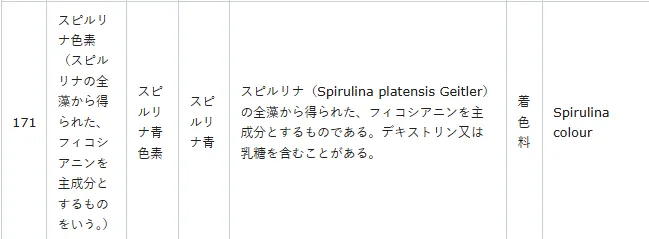
Japan has a long history of utilizing natural color ingredients and generally adopts a specification-oriented regulatory approach. Spirulina-derived color ingredients have been used commercially in the Japanese market for many years, particularly in confectionery, beverages, and specialty food products.
Regulatory assessment focuses heavily on product specifications, manufacturing controls, safety data, and intended use conditions.
Regulatory Resources
China – Spirulina-Derived Blue Color Regulations
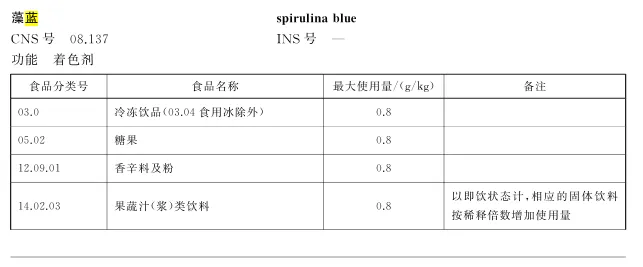
China regulates spirulina-derived blue color ingredients under the National Food Safety Standards framework, with usage conditions defined by specific food additive standards such as GB 2760.
Historically, Spirulina-derived blue color ingredients have been regulated as food additives under specific national standards and usage conditions.
In certain regulatory interpretations applied by companies such as BINMEI, Spirulina Extract may be positioned as a pigment-rich food ingredient rather than a conventional food additive, which can result in different usage considerations compared to standard additive-level applications, depending on market-specific regulatory classification.
Regulatory Resources
- National Health Commission of China (GB 2760)
Other Major Markets – Canada, Australia & New Zealand
1. Australia & New Zealand (FSANZ Framework)
Australia and New Zealand operate under a closely aligned regulatory system governed by Food Standards Australia New Zealand (FSANZ), which administers the joint Food Standards Code for both markets.
Within this framework, FSANZ is responsible for regulating food additives and colouring ingredients. The regulatory assessment of Spirulina-derived ingredients is typically based on multiple factors, including ingredient identity, manufacturing process, intended technological function, and final product classification.
2. Canada (Health Canada Framework)
In Canada, food colouring ingredients are assessed under the Food and Drugs framework administered by Health Canada.
The regulatory status of Spirulina-derived ingredients may vary depending on ingredient identity, manufacturing process, intended use, and supporting technical documentation. As with other jurisdictions, compliance is determined through a combination of ingredient specification and regulatory listing within permitted food additive frameworks.
Regulatory Resources
- Food Standards Australia New Zealand (FSANZ)
- Health Canada-List of Permitted Food Colours (Lists of Permitted Food Additives) ↓
International Framework: JECFA & Codex GSFA
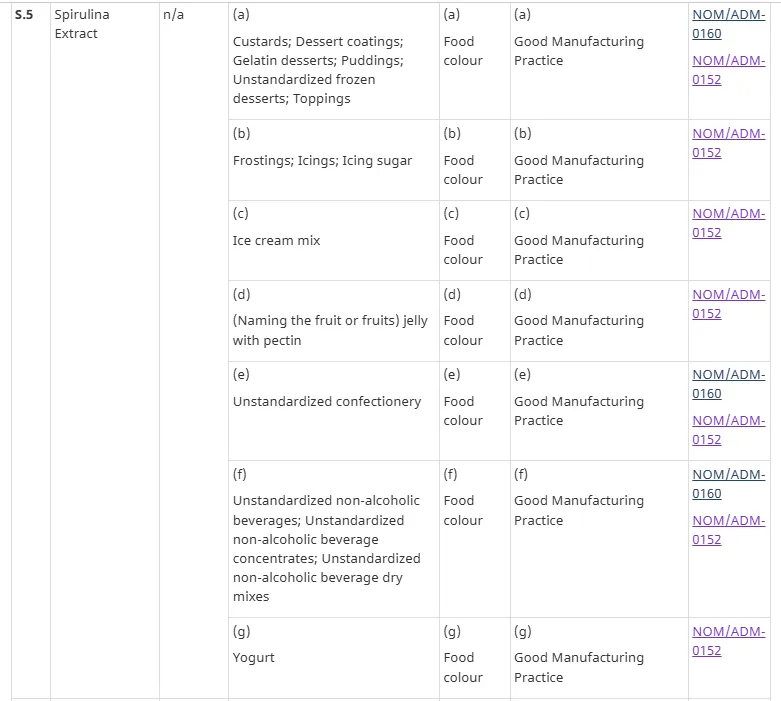
JECFA (Joint FAO/WHO Expert Committee on Food Additives) provides scientific evaluation that forms the basis for Codex Alimentarius standards, including the General Standard for Food Additives (GSFA). These international frameworks are widely used as reference points for food additive classification and usage conditions across multiple regulatory jurisdictions.
Under the Codex GSFA framework, Spirulina Extract (phycocyanin-rich coloring) is listed as a color additive with conditions of use defined by Good Manufacturing Practice (GMP). Its classification and usage parameters serve as an important global reference for evaluating regulatory alignment across different markets.
While regional regulations may differ in implementation, the Codex GSFA system provides a harmonized baseline for understanding how Spirulina-derived color ingredients are evaluated at an international level.
Regulatory Resources
- FAO GSFA Database
What This Means for Brands
Understanding Blue Spirulina Regulations across different markets is essential for determining product feasibility and global commercialization strategy.
Successful market access increasingly depends on:
- Regulatory pathway assessment
- Ingredient characterization
- Manufacturing transparency
- Technical documentation
- Reliable supplier support
For brands,early-stage regulatory alignment can significantly reduce commercialization risks and accelerate global market entry.
BINMEI: Your Partner for the Future of Natural Blue
At BINMEI, we believe that long-term success in global markets requires more than simply being natural. It requires ingredients that can be consistently understood, accepted, and validated across different regulatory systems and application environments.
If you are exploring global opportunities for Blue Spirulina or phycocyanin-based products, we welcome the opportunity to discuss regulatory considerations, application development, and market strategies with you.
Together, we can build more stable, compliant, and sustainable natural blue solutions for the future.