Blue Spirulina VS Green Spirulina
Blue Spirulina vs Green Spirulina: Nutrition, Taste, Color and Food Applications
Spirulina has become familiar to many consumers through smoothie bowls, wellness drinks, plant-based foods and naturally colored desserts. But when people compare blue spirulina vs green spirulina, they often discover that the two ingredients are not used in the same way.
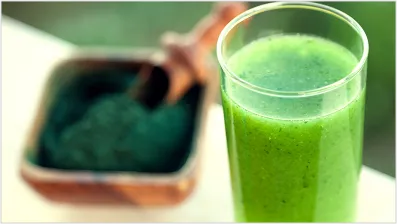
Green spirulina is usually understood as spirulina powder made from the whole algae biomass. Blue spirulina, on the other hand, is commonly used to describe spirulina extract, a phycocyanin-rich blue ingredient extracted from spirulina. This difference affects nutrition, taste, color performance and how each ingredient works in food and beverage applications.
For food brands, product developers and everyday users, the question is not simply which one is better. A more useful question is: which one fits your goal better? If you want a broader spirulina-based nutritional profile, green spirulina powder may be the more suitable choice. If you want a clean natural blue color with a milder flavor impact, blue spirulina extract is often the better option.
Quick Answer: Blue Spirulina vs Green Spirulina
The simplest way to understand blue spirulina vs green is this:
- Green spirulina is closer to the whole spirulina ingredient. It is valued for its blue-green appearance, plant-based nutrition, protein content and use as a natural green or blue-green coloring ingredient.
- Blue spirulina is a spirulina extract mainly known for its phycocyanin content and vivid blue color. It is often selected when natural blue coloring, water solubility and low flavor impact are important.
In practical food applications, spirulina vs blue spirulina is often a choice between a broader whole-ingredient approach and a more targeted color solution. Green spirulina supports nutrition and a green-blue natural color direction. Blue spirulina extract supports bright blue visual design in beverages, dairy, ice cream, confectionery and other selected applications.
The Core Difference: Whole Spirulina Powder vs Spirulina Extract
To understand blue spirulina vs spirulina, it is important to look at how the ingredients are made.
What Is Green Spirulina?
Green spirulina generally refers to spirulina powder made from spirulina biomass. BINMEI’s Spirulina Superfine Powder is made from high-quality spirulina through processes such as high-pressure wall breaking, homogenization, emulsification, filtration and disinfection. According to BINMEI product information, the particle diameter can be less than 20 μm, helping improve texture, color uniformity and ease of mixing.
Compared with ordinary spirulina powder, this superfine form is designed to be closer to a completely water-soluble state. For food and beverage applications, that matters because a finer powder can disperse more evenly, reduce visible particles and support more consistent coloring.
What Is Blue Spirulina?
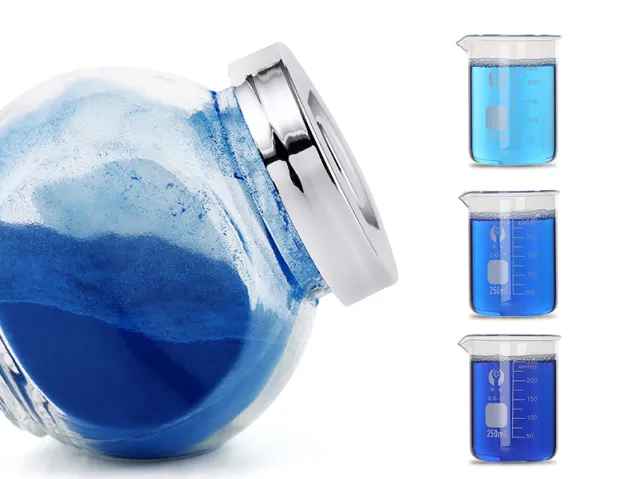
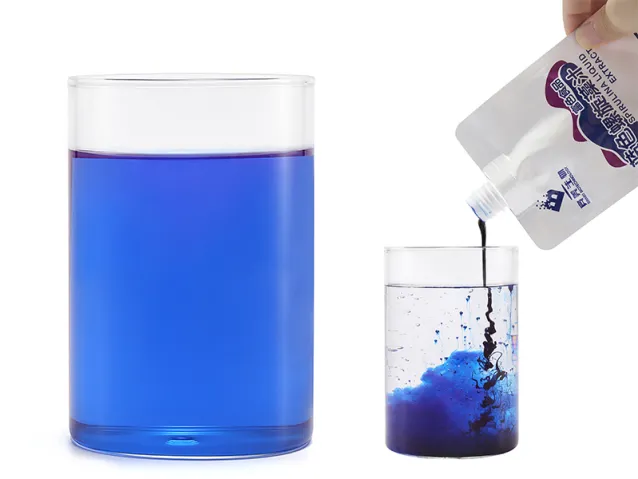
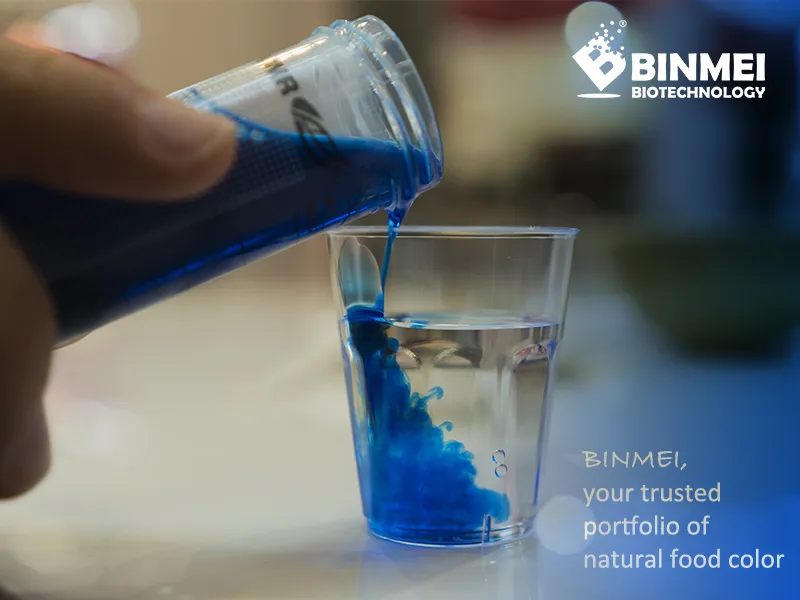
Blue spirulina usually refers to spirulina extract, also known as phycocyanin powder. BINMEI’s Spirulina Extract is a blue powder extracted from spirulina, with phycocyanins as the principal coloring components. BINMEI describes its spirulina extract as water soluble, quickly dissolving in cold and warm water without clumping.
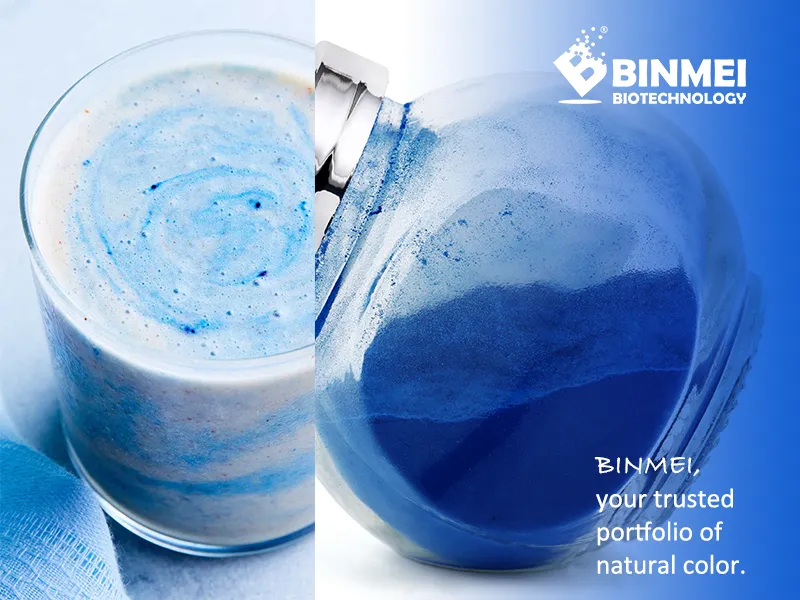
This makes blue spirulina extract especially useful when the goal is a clean blue shade rather than a green-blue whole spirulina appearance. It is commonly considered for applications such as beverage mixes, powders, yogurts, frozen desserts, dessert coatings, toppings, confectionery and similar food systems where blue color is part of the product identity.
Green Spirulina vs Blue Spirulina: Key Comparison
The following table summarizes the practical difference between green spirulina vs blue spirulina from a food application point of view.
| Comparison Point | Green Spirulina Powder | Blue Spirulina Extract |
|---|---|---|
| Ingredient type | Whole spirulina-based powder | Phycocyanin-rich spirulina extract |
| Color direction | Blue-green to green natural color | Bright blue natural color |
| Typical purpose | Nutrition plus natural coloring | Natural blue food coloring and phycocyanin-focused use |
| BINMEI product example | Spirulina Superfine Powder | Spirulina Extract / Phycocyanin Powder |
| Solubility and dispersion | Designed to be close to a completely water-soluble state, with fine texture and uniform coloring | Water soluble and dissolves quickly in cold and warm water without clumping |
| Protein-related data | BINMEI COA lists protein at ≥30 g/100 g for Spirulina Superfine Powder | BINMEI product information lists protein at 15–70% and phycocyanin at 10–60% depending on specification |
| Flavor impact | More noticeable spirulina taste and aroma than blue extract | Usually easier to use when a lighter sensory impact is preferred |
| Best fit | Green drinks, nutrition-oriented products, plant-based food concepts and natural green-blue coloring | Blue beverages, smoothie bowls, yogurt, ice cream, confectionery, toppings and cold or low-heat applications |
Nutrition: Which One Is More Complete?
If the main question is nutrition, green spirulina powder usually has the advantage because it retains more of the whole spirulina matrix. It can contribute protein, minerals, vitamins and natural pigments associated with spirulina. BINMEI’s Spirulina Superfine Powder product information lists protein at ≥30 g/100 g and describes the product as suitable for both food coloring and functional ingredient use.
Blue spirulina extract is different. Its value is more focused on phycocyanin and natural blue color performance. BINMEI’s Spirulina Extract product information lists phycocyanin content in the range of 10–60% depending on the specification, with E18 provided as a reference specification showing a color value of 180–195.
This means blue spirulina vs spirulina should not be treated as a simple nutritional contest. Green spirulina powder is closer to a whole spirulina ingredient. Blue spirulina extract is more specialized and is often selected when the product requires blue color, good water solubility and phycocyanin-focused functionality.
Taste and Sensory Difference
Taste is one of the biggest reasons people compare green vs blue spirulina. Green spirulina tends to have a stronger algae-like, earthy or marine note. In home recipes, it is often paired with pineapple, citrus, mango or other strong flavors. In commercial food and beverage development, this sensory impact must be considered carefully because it may influence the final flavor profile.
Blue spirulina extract is generally easier to use when the product needs a cleaner taste profile. Because it is an extracted ingredient rather than the whole green biomass, it usually has a lower flavor impact. This is why blue spirulina has become popular in visually driven products such as blue smoothie bowls, blue lattes, frozen desserts and colored toppings.
From a food coloring perspective, the difference is clear: green spirulina powder can support a natural green or blue-green product identity, while blue spirulina extract is better when the visual goal is a clear and attractive blue shade.
Color Performance in Food Applications
For BINMEI and other food ingredient suppliers, the most important comparison is not only nutrition. It is also how each ingredient performs in real product systems.
When Green Spirulina Powder Works Better
Green spirulina powder is useful when the product concept allows a green or blue-green appearance and when the brand wants to communicate a plant-based or spirulina-related ingredient story. BINMEI’s Spirulina Superfine Powder is designed for better dispersion, fine texture and uniform coloring compared with ordinary spirulina powder.
This makes it more suitable for applications where both nutrition and natural color matter, such as:
- Green smoothies and powdered drink mixes
- Plant-based beverage concepts
- Functional food products
- Natural green-blue coloring in selected food systems
- Products where spirulina identity is part of the selling point
When Blue Spirulina Extract Works Better
Blue spirulina extract is more suitable when the product needs a bright blue color without the stronger taste and appearance of green spirulina powder. BINMEI’s Spirulina Extract is water soluble and can dissolve quickly in cold and warm water, making it practical for many beverage and dessert applications.
It is commonly considered for:
- Blue beverages and beverage powders
- Blue smoothie bowls and smoothie mixes
- Yogurt, custards, puddings and dairy-style products
- Ice cream and frozen desserts
- Confectionery, candy and chewing gum
- Frostings, dessert coatings and toppings
For brands that need a natural blue colorant, blue spirulina extract is often the more direct choice. For brands that want spirulina nutrition and a green-blue look, green spirulina powder may be more suitable.
Heat, pH and Light: Why Application Conditions Matter
A major difference in blue spirulina vs green spirulina selection is stability. Blue spirulina extract contains phycocyanin, a protein-based pigment. This makes it attractive as a natural blue color, but it also means application conditions must be controlled.
According to BINMEI product information, spirulina extract may fade under certain light, heat, acidic or alkaline conditions. BINMEI recommends not heating the product above 60°C after adding spirulina extract. For products such as yogurt, the extract is recommended to be added after pasteurization to help avoid fading. In jelly or similar systems, adding spirulina extract after the solution cools to about 60°C can help maintain color.
pH also matters. BINMEI notes that spirulina extract is stable around pH 4.5–8.0, while precipitation may occur when pH is lower than 4.2. The company also recommends avoiding sun exposure and keeping the product sealed after opening.
Green spirulina powder may provide stronger stability than ordinary spirulina powder when processed into a superfine form, but it still needs to be tested in the actual product system. Color performance can change depending on water activity, heating process, base color, pH, storage and packaging.
Application Selection Table: Which One Should You Use?
For most users, the easiest way to decide between green spirulina vs blue is to start with the final application.
| Application Goal | Better Choice | Reason |
|---|---|---|
| Bright blue smoothie bowl | Blue spirulina extract | Provides a clean blue shade with lower flavor impact |
| Green nutrition drink | Green spirulina powder | Supports whole spirulina positioning and green-blue color |
| Blue beverage powder | Blue spirulina extract | Water soluble and suitable for beverage mixes |
| Product emphasizing spirulina nutrition | Green spirulina powder | Closer to the complete spirulina ingredient |
| Ice cream or frozen dessert with blue color | Blue spirulina extract | Works well in cold applications when pH and light exposure are considered |
| High-heat baked goods | Test before launch | Blue spirulina extract is heat-sensitive; green spirulina may also change depending on formulation |
| Clean-label confectionery | Blue spirulina extract or green spirulina powder, depending on target color | Blue extract supports blue shade; green powder supports green-blue natural color direction |
How BINMEI Evaluates Blue and Green Spirulina for Food Coloring
As a natural color supplier, BINMEI evaluates spirulina ingredients not only by their nutrition profile, but also by their performance in food and beverage systems. For commercial applications, the practical question is not only “Which one is healthier?” but also “Which one can deliver the expected color, taste and stability in the finished product?”
For blue spirulina extract, BINMEI focuses on factors such as color value, solubility, pH range, heat sensitivity, light exposure, recommended addition level and application fit. For reference, BINMEI suggests an addition level of about 0.05%–0.1% of total product weight, with 0.08% described as a common usage level. In beverage development, the recommended range may translate to about 0.5 g to 1 g of spirulina extract for 1 kg of beverage, depending on the desired blue shade.
For green spirulina superfine powder, BINMEI focuses on particle size, dispersion, uniform coloring, solubility improvement and food safety testing. The product is listed as blue-green powder with 98% passing 200 mesh, and it is designed to be easier to mix and use than ordinary spirulina powder.
This first-hand product perspective gives a more practical answer to spirulina vs blue spirulina: the better choice depends on whether the formulation needs whole spirulina character or targeted natural blue color performance.
Quality Checklist Before Choosing a Spirulina Ingredient
Whether choosing blue or green spirulina, quality should be part of the decision. Spirulina is a natural ingredient, so raw material control, processing, testing and documentation matter.
- Check product specification: Review appearance, solubility, particle size, color value or phycocyanin content depending on the product type.
- Review heavy metal limits: BINMEI product information lists heavy metal testing for lead, arsenic, cadmium and mercury for both spirulina extract and spirulina superfine powder.
- Consider microbiological standards: For food applications, microbial testing is an important part of supplier evaluation.
- Match the ingredient to the process: Blue spirulina extract should be protected from excess heat, strong light and unsuitable pH conditions.
- Ask for application support: Commercial food projects should test the ingredient in the actual product system before launch.
BINMEI provides product documentation, application support and samples for R&D testing. For brands developing beverages, dairy products, confectionery, frozen desserts or powder mixes, this kind of testing support is important because color performance can change from one formulation to another.
Final Verdict: Blue Spirulina vs Green Spirulina
There is no absolute winner in blue spirulina vs green spirulina. They serve different purposes.
Choose green spirulina powder if you want a spirulina-based ingredient with a broader whole-food profile, blue-green natural color, protein contribution and plant-based product identity. BINMEI’s Spirulina Superfine Powder is especially relevant when better dispersion, fine texture and more uniform coloring are needed.
Choose blue spirulina extract if your main goal is a vivid natural blue color, water solubility, low flavor impact and good performance in cold or low-heat food applications. BINMEI’s Spirulina Extract is especially suitable for blue beverages, smoothie bowls, yogurt, frozen desserts, confectionery and dessert decorations when stability conditions are properly managed.
For food manufacturers, the best decision comes from matching the ingredient to the application. Green spirulina is stronger when the product story is about spirulina nutrition and natural green-blue identity. Blue spirulina is stronger when the product needs a clean blue color and a more controlled sensory profile.
FAQ
Is blue spirulina the same as green spirulina?
No. Green spirulina is generally closer to whole spirulina powder, while blue spirulina usually refers to spirulina extract rich in phycocyanin. They come from related raw material sources, but they are processed and used differently.
What is the main difference between blue spirulina vs spirulina?
Spirulina usually refers to the whole algae ingredient. Blue spirulina is a spirulina extract focused on the blue pigment phycocyanin. For nutrition-oriented use, spirulina powder may be more complete. For natural blue coloring, blue spirulina extract is usually more suitable.
Which one tastes better, blue spirulina or green spirulina?
Blue spirulina extract generally has a milder flavor impact than green spirulina powder. Green spirulina often has a stronger algae-like taste and may need stronger flavors to balance it.
Which one is better for food coloring?
It depends on the target shade. Blue spirulina extract is better for bright blue coloring. Green spirulina powder is better when a green or blue-green spirulina-based appearance is desired.
Can blue spirulina be heated?
Blue spirulina extract is heat-sensitive. BINMEI recommends not heating products above 60°C after adding spirulina extract. For yogurt and similar products, adding it after pasteurization or after cooling can help maintain color.
What pH is suitable for blue spirulina extract?
BINMEI product information notes that spirulina extract is stable around pH 4.5–8.0. Precipitation may occur when pH is lower than 4.2, and strong alkaline conditions may cause fading.
Which one should food brands choose?
Food brands should choose based on the product concept, color target, processing conditions and flavor requirements. Blue spirulina extract is better for natural blue color. Green spirulina powder is better for whole spirulina identity and natural green-blue applications.